The School That Left No Books
India's materialists argued for nineteen centuries and not one of their own texts survives. Everything we quote from them was written down by people trying to refute them, and the popular story gets that wrong in both directions.
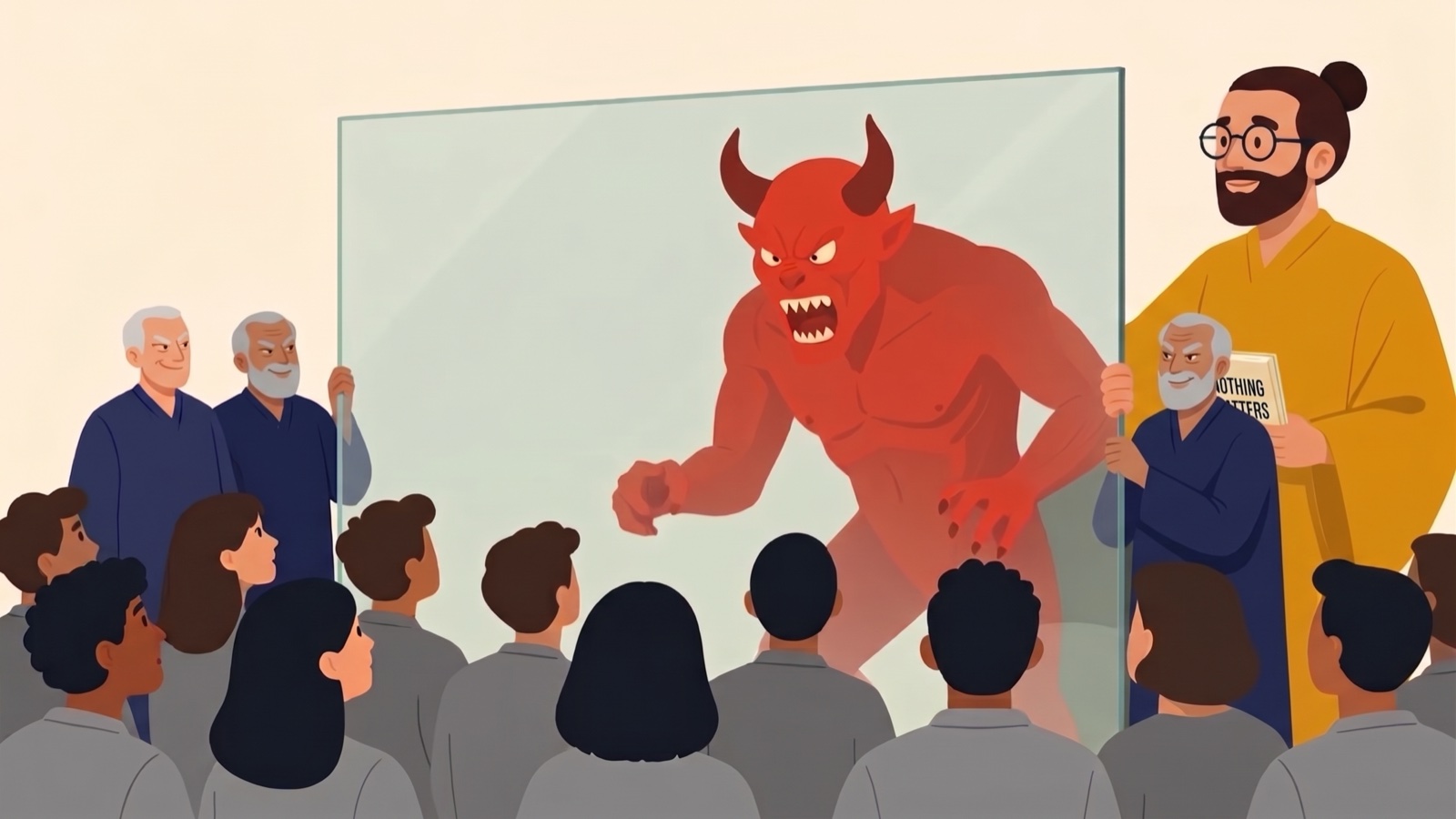
Sometime around 1380, at a monastery in what is now Karnataka in southern India, a Vedanta scholar sat down to catalogue every philosophical system in the country. He built the book as a ladder. Sixteen schools, arranged in ascending order of truth as he understood it, with his own school waiting at the top. The lowest rung, chapter one, went to the materialists.
He gave them a hearing before demolishing them, which is the only reason anyone can quote them today. And he opened with a complaint: "The efforts of Charvaka are indeed hard to be eradicated, for the majority of living beings hold by the current refrain: While life is yours, live joyously; none can escape Death's searching eye." A scholar at the top of the religious establishment, writing in the fourteenth century, describing the materialist position as the default setting of ordinary people.
The quotation preserves the materialists. It also frames them, in the act of preserving them, as a vulgar popular habit, and refuses them the standing of a school of thought. Every word we have from the Charvakas reaches us through a filter like that one.
So the problem here is a plain one, and it is not unique to India. A group of people argued a position for a very long time. They wrote books. Not one of those books survives, in whole or in part, in a copy made by someone who agreed with them. What we have instead are quotations, summaries and paraphrases embedded in the works of their opponents, who quoted them in order to knock them down. The question is what you can actually establish about a set of beliefs when every surviving sentence passed through the hands of people who wanted the belief dead.
There is a second question sitting on top of the first, and it is the one that brings most people to this subject now. The Charvakas are regularly offered as proof that the Indian religious tradition was uniquely hospitable to unbelief, an argument that runs: even our atheists were ours. They are just as regularly offered as proof of the opposite, that the tradition crushed dissent so thoroughly it erased the library. Both of those claims are checkable. Neither of them survives the check intact.
Everything we know, we know from the prosecution
Start with the names, because even those are unstable. Charvaka (Sanskrit Cārvāka) and Lokayata (Lokāyata, roughly "prevalent in the world", or "of this world") are used more or less interchangeably in the later literature for the same materialist position. Whether they started as the same thing is disputed. Tradition attributes the school's foundational text to a figure called Brihaspati, and calls that text the Brihaspati Sutra or Barhaspatya Sutra. A sutra in this context is a text written as a chain of very short aphorisms, compressed almost to the point of being unreadable without a commentary, which is how a great deal of Indian philosophy was composed.
The Brihaspati Sutra is lost. So is every commentary on it. We know the commentators' names because their opponents cited them by name while disagreeing with them: Aviddhakarna, Udbhata, Purandara. That is the entire institutional memory of a philosophical school, three names preserved in the footnotes of people who thought they were wrong.
What does survive is a scatter of quoted aphorisms and verses. The Bengali scholar Dakshinaranjan Shastri gathered sixty of them in 1928. Ramkrishna Bhattacharya, whose 2002 article in the Journal of Indian Philosophy and 2009 book Studies on the Carvaka/Lokayata are now the standard reference, produced a stricter collection running to sixty-eight numbered items. Bhattacharya attaches a warning to his own work that is worth repeating: the longer the list of fragments grows, the higher the chance that misquotations and foreign material have been swept into it. Most of the fragments come from works composed between the eighth and twelfth centuries CE, which is to say roughly a thousand years after the ideas themselves first appear in the record.
| Source | Date | Author's stake | What it gives |
|---|---|---|---|
| Samannaphala Sutta Buddhist canon |
Text c. 4th c. BCE, reporting c. 500 BCE | Buddhist. Lists six rival teachers to show the Buddha surpassed them. | The earliest datable statement of Indian materialism, put in the mouth of Ajita Kesakambali. |
| Ramayana, Ayodhya Kanda and Mahabharata, Shanti Parva |
c. 400 BCE – 400 CE | Brahmanical epic. Materialism appears as a position to be defeated. | Two set-piece confrontations. Also the clearest evidence of later editors hardening the hostility. |
| Philosophical refutations Buddhist, Jain, Nyaya, Mimamsa, Vedanta |
c. 6th–14th c. CE | Opponents quoting to refute. The house style of Indian philosophy. | Nearly all the surviving aphorisms, and the named commentators. |
| Tattvopaplavasimha Jayarasi Bhatta |
c. 8th c. CE. Found 1926, printed 1940 | Possibly an insider. Disputed. | The only candidate for a primary text. Radical scepticism about all knowledge, which is not the same doctrine as materialism. |
The one item in that table with any claim to being a primary source is where the field's sharpest disagreement sits. In 1926 a manuscript turned up of a work called the Tattvopaplavasimha, which translates roughly as The Lion That Devours All Categories, by an author named Jayarasi Bhatta. It was published in 1940. Its editors, Sukhlalji Sanghavi and Rasiklal Parikh, presented it as a genuine work from within the Lokayata tradition, and the Austrian-trained scholar Eli Franco has argued the same, calling it the only Lokayata text discovered so far.
Others disagree, including Bhattacharya, Debiprasad Chattopadhyaya and Karel Werner. Their objection is substantive rather than procedural. Jayarasi's project is to show that no means of acquiring knowledge can be validated at all, which lands him in a universal scepticism that undercuts the materialist's own confidence in the evidence of the senses. A materialist says the world is matter and you can see it. Jayarasi says you cannot establish that you can see anything. Those are different books.
Four elements, one life, and a low opinion of priests
Strip the caricature away and a compact, coherent position is visible underneath. The world is made of material elements, usually given as four: earth, water, fire and air. Consciousness is not a separate substance. It arises when those elements are combined in a living body, in the way that an intoxicating power arises when particular ingredients are fermented together. The comparison is theirs, or at least is attributed to them consistently. When the body breaks up, the consciousness that arose from it stops. There is no soul that travels onward.
Everything else follows from that. No rebirth, so no karma in the technical sense of moral bookkeeping carried across lives. No moksha, the liberation from the cycle of rebirth that almost every other Indian school treats as the point of the whole exercise. No heaven, no hell, no ancestors waiting to be fed. That last one had teeth, because shraddha, the ritual offering of food to dead ancestors, was and is a central obligation of Brahmanical practice, and the materialists pointed out that if food given here reaches a person elsewhere, you might as well stop packing lunch for a traveller and just offer it at the front door on his behalf.
The oldest clear statement of this position in any datable text is not Charvaka at all. It belongs to Ajita Kesakambali, "Ajita of the hair blanket", one of six non-Buddhist teachers described in the Samannaphala Sutta of the Pali Buddhist canon as contemporaries of the Buddha in the fifth century BCE. The sutta has him say that a man is built of four elements, that at death earth returns to earth and water to water and the senses pass into space, and that the wise and the foolish alike are annihilated. He is quoted there to be dismissed. He is quoted accurately enough that the doctrine is legible twenty-five centuries later.
Consciousness arises from the body the way intoxication arises from fermented ingredients. Neither was present in the parts.
The epistemology is where the standard textbook account goes wrong, and where the modern scholarship has genuinely moved. Pramana is the Sanskrit term for a valid means of acquiring knowledge, and the number a school accepts is close to a fingerprint for it. Almost every account you will read says the Charvakas accepted exactly one, direct perception, and rejected inference outright. The obvious objection writes itself, and Indian opponents made it constantly: the claim that inference is invalid is itself arrived at by inference.
The fragments do not support the crude version. Purandara, one of the three named commentators, is quoted by the Buddhist philosopher Kamalashila as accepting lokaprasiddham anumanam, inference as it is well established in the world. Gunaratna, a Jain commentator, records the same position: the Charvakas accept the kind of inference that tells you there is fire on the hill because you can see smoke, since you can test that one by going and looking, and reject the kind that claims to establish heaven, or unseen merit, or a soul, because nothing about those is available to check. Bhattacharya's conclusion, argued across the 2009 volume, is that the commentators were unanimous on this. Perception is primary. Inference is admitted, and it is secondary, valid only where it stays tethered to something someone could in principle observe.
That one digit is the difference. A school's most famous doctrine turns out to be the version its opponents needed it to hold in order to refute it cleanly, and the version reconstructed from its own quoted words is more careful and much harder to dismiss.
The same pattern runs through the ethics. The line everyone knows is rnam krtva ghrtam pibet, "having incurred debt, one should drink ghee", usually rendered as: borrow money if you must, but enjoy yourself, because there is no creditor waiting in the next world. It is the single most-quoted sentence of Indian materialism. It appears in the fourteenth-century compendium with no source given, versions of it turn up in the Vishnu Purana and in plays and poems, and Bhattacharya devotes a chapter to the question of who actually said it. His answer is that the author of the compendium was reproducing a distorted popular verse, not quoting a Charvaka text. No authentic Charvaka aphorism has ever been produced in support of the charge that the school taught unrestrained sensual gratification. The charge was made for eight hundred years anyway.
The categories that decide the question were invented late
Now to the claim that sends most people looking. Were the Charvakas Hindus? Were they an accepted stream of the tradition?
The technical vocabulary is astika and nastika. The usual gloss is orthodox and heterodox, and the test is not belief in God. It is acceptance of the Vedas, the oldest Sanskrit religious texts, as an authoritative source of knowledge. By that test Samkhya counts as astika while holding no creator god, and Buddhism counts as nastika while carrying an enormous metaphysics. On the standard classification the astika schools are the six known as the shad-darshana, the six viewpoints: Nyaya, Vaisheshika, Samkhya, Yoga, Mimamsa and Vedanta. The nastika schools are Buddhism, Jainism and Charvaka.
So on the conventional grid, the Charvakas are filed outside, in the same column as two religions nobody calls Hindu. That is the short answer, and it is the wrong shape of answer, because the grid itself has a history.
Andrew Nicholson's Unifying Hinduism (2010) makes the case, now widely accepted, that no single well-demarcated boundary between astikas and nastikas existed before the late medieval period. His argument is that between roughly the twelfth and sixteenth centuries CE a group of writers working in a genre called doxography, the compiling and ranking of rival systems of thought, began treating the Upanishads, the epics, the Puranas and the six schools as a single whole united by their commitment to the Veda, and defined against the Buddhists, Jains and materialists. Madhava's compendium of around 1380 is one of those works. Vijnanabhikshu in the sixteenth century is another. On Nicholson's reading this is where the conceptual architecture of a unified Hinduism gets built, and the nineteenth-century Indian and European thinkers who coined the word "Hinduism" were working downstream of it.
Before that consolidation the categories were genuinely fluid, and you can watch them wobble. The Jain scholar Haribhadra, writing in the eighth century, compiled his own survey of six systems and it is not the familiar six: Buddhist, Nyaya, Samkhya, Jain, Vaisheshika and Mimamsa, with Lokayata added in a short closing section. Here a Jain thinker counted Buddhists and materialists among the six and left Vedanta out entirely. The number six was traditional. What went into it was not settled.
Which means the question "were the Charvakas Hindus" contains a hidden anachronism. For most of the period in which Charvakas were actually arguing with people, there was no consolidated Hinduism for them to be inside or outside of. There were competing schools, some of which accepted the Vedas and many of which did not, all arguing in a shared technical language. Once the consolidation did happen, the materialists ended up outside the line, and they ended up there by name.
What the record shows, and what it does not
The hostility is real, sustained, and easy to document. It is also more specific than the phrase "systematically demonised" suggests, and the specifics cut in more than one direction.
Take the two epic confrontations. In the Ramayana, the sage Jabali, a counsellor in the court of Rama's father, argues Rama out of his exile using recognisably materialist reasoning: there is no other world, the rituals for the dead are a waste, a man who gives up material goods for the sake of duty suffers here and is extinguished afterwards. Rama's reply is not a refutation so much as a demand for punishment. In the Ayodhya Kanda he says that an atheist is to be treated as a thief, that such a man is the most suspect and should be punished in the interest of the people, and that no wise man should keep company with one. He then denounces his own dead father for having kept Jabali as an adviser.
Jabali's response to being shouted at by an incarnation of Vishnu is to say that he was not actually a materialist and had only been arguing like one to get Rama to come home. Bhattacharya's study of the episode, using the critical edition of the Sanskrit text, shows something more interesting than the retraction: several of the verses that most viciously denigrate Jabali and brand him an opportunist are interpolations, later insertions absent from the oldest recoverable version. The hostility in the text grew over time. Someone kept going back in to make the materialist look worse.
The Mahabharata is blunter. In the Shanti Parva, the twelfth book, a character named Charvaka appears at Yudhishthira's coronation disguised as a Brahmin, insults the new king in front of the assembly, and is burned to death on the spot by the collective anger of the Brahmins present. The text is explicit that he is a rakshasa, a demon, and a personal friend of the villain Duryodhana, and that his destruction was prophesied. The materialist school's name is attached to a demon, the demon is killed by holy men, and the narrative arranges matters so that the killing is both deserved and foretold.
In the legal literature the exclusion is administrative rather than dramatic. Manusmriti 2.11 marks out the man who relies on argumentative reasoning to slight the Vedas as one to be excluded, cast out of the company of the virtuous. The commentator Medhatithi, writing centuries later, glosses the offending reasoning as that of the Buddhists and Charvakas by name. At 4.30 the hetuka, the man of arguments, is listed among those not to be honoured. This is social and ritual exclusion, prescriptive text that says what should be done and records nothing that happened.
400 CE
200 CE
Here is the part the indignant version leaves out. There is no surviving record of a campaign to destroy Charvaka books. No edict, no burning, no named execution of a materialist for materialism, no inquisitorial apparatus of the kind that would leave the documentary trail such campaigns usually leave. The demonising is in the literature and it is undeniable. The book-burning is an inference from the absence of books, and it is not the only available inference, or the strongest one.
A manuscript needs a building and a reason
Before printing, a text stays alive only by being copied, and copying is expensive. Someone has to prepare the palm leaf or the birch bark, feed and house a scribe, and then do the whole thing again a generation or two later when the material rots, which in the Indian climate it reliably does. There is no passive survival: without a fresh copy, the text ends.
That work got done, in practice, inside institutions with a standing reason to do it. Buddhist and Jain monasteries copied their canons as an act of merit and a condition of their own continuity. Brahmanical lineages transmitted the Vedas and their commentaries through families and schools funded by land grants and royal patronage. Every school that survives into the modern record survives because some institution had both the buildings and the motive.
The Charvakas appear to have had neither. No monastery, no lineage of teachers with an endowment, no ritual function for a king to fund, and a doctrine that explicitly denied the existence of merit that copying a text could earn. They taught, as far as the record shows, through argument and public debate rather than through an institution. Add the active hostility already documented, which would have made a Brahmanical household an unlikely place to keep a Charvaka manuscript in good repair for a thousand years, and the outcome does not require a conspiracy.
This does not claim that nothing hostile happened. It is about what the absence of books can and cannot prove on its own. Enormous quantities of Sanskrit literature are lost, including work by schools nobody was persecuting, because the copying stopped. The Charvaka loss is close to total, rather than merely severe, because of the combination: no institution with a reason to copy, plus an establishment with a reason not to.
A text without a monastery behind it is a text with a lifespan.
There is a comparison that makes the point cleanly. Jainism in this same period was also nastika, also rejected the Vedas, and also got demonised in Brahmanical literature. It is still here, with its libraries intact, and Jain manuscript collections are in fact one of the places modern scholars go to recover Charvaka fragments. The Jains were not spared the hostility. They simply had the buildings the Charvakas lacked.
Both halves of the popular version fail, in opposite directions
A comment posted on a public forum, and the edit its author later added underneath it, between them cover most of what gets said about the Charvakas in general circulation. The original holds that they were non-believers who rejected the Vedas, that they are still Hindus, and that they form an accepted stream of Hinduism. The edit withdraws all of that and holds instead that they were systematically demonised and their literature destroyed. Neither version is stupid. Each is half right, and the halves do not overlap, so the table below takes the statements apart clause by clause and judges each one against the sources laid out above rather than against the most charitable thing its author might have meant.
| Claim | Verdict | Basis |
|---|---|---|
| "We had the Charvak philosophy of non-believers who rejected the vedas." | Supported | Rejection of Vedic authority is the defining feature in every source, hostile and otherwise. It is also the only claim here that no scholar disputes. |
| "They are still hindus." | Anachronistic | On the standard astika/nastika classification they sit outside, with Buddhism and Jainism. But that classification, per Nicholson (2010), hardened only between the twelfth and sixteenth centuries, long after the school was finished. For most of its life the category did not exist to be inside or outside of. |
| "An accepted stream of hinduism." | Contradicted | Catalogued is not accepted. Madhava places them on the lowest rung of a ladder; Manusmriti 2.11 prescribes exclusion; the Ramayana has Rama call for the punishment of atheists; the Mahabharata names a demon after the school and burns him alive. |
| "They were systematically demonised." | Supported | Demon in the Mahabharata, comic villain in the drama, hedonist in the compendia on the strength of a verse with no attested Charvaka source, and denigrating verses demonstrably interpolated into the Ramayana after the fact. |
| "Their literature destroyed." | Unsupported as stated | The literature is certainly gone. No evidence exists of a campaign of destruction: no edict, no burning, no trial. The better-supported account is an absence of any institution with a reason to keep copying, in an environment hostile enough that nobody else would. |
| "They had the guts to stand for their convictions." | Unverifiable | Not a factual claim that the sources can settle. No Charvaka's own account of their own courage survives, because no Charvaka's own account of anything survives. |
That split recurs whenever an old tradition gets recruited into a modern argument about itself. The first version is generous in a way the record will not support, because it wants a civilisation plural enough to have housed its own unbelievers comfortably. The correction is indignant in a way the record will not support either, because it wants a crime with a culprit. Both want a verdict. What the sources actually show is slower than either of those, and leaves nobody in particular to blame, which is most of the reason neither side of the modern argument has much use for it.
Who has wanted the materialists back, and why
The school stopped existing as an organised tradition somewhere around the twelfth century. The idea kept moving.
In the 1570s the Mughal emperor Akbar built a hall at Fatehpur Sikri, near Agra, for debates between representatives of different religions and philosophies. His chronicler Abul Fazl records Charvaka thinkers among the participants, and credits them with promoting just administration and benevolent argument, comparing them to the Greek Sophists. Jesuit missionaries at the court, among them Rodolfo Acquaviva and Antoni de Montserrat, reported the proceedings back to Europe from 1582 onwards. Hannah Chapelle Wojciehowski's 2015 article in Genre traces those reports as a possible channel by which a more detailed European understanding of Indian philosophy, materialism included, began to form in Jesuit writing by the early seventeenth century. Whether ideas actually crossed, as against information about ideas, is not settled.
The modern recovery is largely a twentieth-century Marxist project. Debiprasad Chattopadhyaya's Lokayata: A Study in Ancient Indian Materialism (1959) set out to demolish the idea that Indian philosophy was exclusively concerned with the transcendent, and reconstructed the materialist tradition from the hostile fragments. His conclusions have not aged uniformly. He argued for a proto-materialism predating the Vedas, rooted in an agricultural and matriarchal society, and critics have charged that this forces a fluid record into a rigid schema of class struggle. Bhattacharya, who calls Chattopadhyaya's work pioneering, also questions his analysis on specifics. The reconstruction survives. The Marxist historiography around it is contested.
And the Charvakas are now claimed by everyone, which is the surest sign that almost nothing about them is settled. Indian rationalist and atheist organisations claim them as an indigenous freethinking lineage, with a Carvaka Ashram in Andhra Pradesh putting up busts of Indian atheists. Hindu apologetic writing claims them as evidence of a tradition so plural it housed its own materialists, sometimes going so far as to describe the school as tolerant and not anti-theistic, which is difficult to square with fragments that call the authors of the Vedas buffoons and knaves. Both camps want the same six fragments to carry a claim about Indian civilisation. The fragments were assembled by people who wanted the school forgotten.
What the evidence supports, at the end, is narrower than any of that. A materialist position was argued in India from at least the fifth century BCE, in technical detail, by named thinkers whose books are gone. It was answered at length by every major school for well over a thousand years, which is the reliable sign that opponents found it dangerous rather than silly. It was caricatured into a doctrine of appetite that its own surviving aphorisms do not support. And it vanished from the record the way most things vanish from the record. No fire was needed; nobody with a building was willing to copy it out again.
Sources & Confidence
DERIVED FIGURES. The ledger's "~1,900 years" is a span computed here from Ajita Kesakambali (c. 500 BCE) to Madhava's compendium (c. 1380 CE), not a figure any source states. The fragment count of 68 is Bhattacharya's own numbering and reflects his editorial judgment about authenticity; earlier collectors counted 60 and 54. The pramana counts in Figure 2 are the standard schematic attributions, and the Charvaka figure of 1 is the opponents' count, marked as such in the caption and argued against in the text.
DEVIATIONS LOG. No map is used: the geography here is a single subcontinent and a locator map would have shown nothing the prose does not. A planned figure comparing manuscript survival rates across schools was cut, because no reliable quantitative data on Sanskrit manuscript survival by school exists and the chart would have rested on invented numbers; the comparison is made in prose instead. Dates for the epics and Manusmriti are redaction ranges and contested within those ranges; the report gives the ranges rather than picking a point. Everything in this page is self-contained except the web fonts.